Tuesday, September 29, 2009

Polymerase: Taking 30 steps forward, taking two steps back ...

The body's nanomachines that read our genes don't run as smoothly as previously thought, according to a new study by University of California, Berkeley, scientists. When these nanoscale protein machines encounter obstacles as they move along the DNA, they stall, often for minutes, and even backtrack as they transcribe DNA that is tightly wound to fit inside the cell's nucleus.

For over 30 years, scientists had wondered how the polymerase responded to the nucleosome, and we were finally able to observe this process directly," Hodges said. "People thought that the polymerase is a powerful motor that would blow through the nucleosome like a bulldozer, but it's surprisingly delicate in its response; if anything is in the way, Pol II stops and backs up.


RNA polymerase II performing gene expression
RNA polymerase II (blue) performs the first step of gene expression by moving along the cell's DNA (gray) and transcribing it into messenger RNA (red). During this process, the polymerase encounters obstacles, such as nucleosomes, which tightly wrap the DNA around histone proteins (yellow) and prevent continued transcription. UC Berkeley researchers have developed methods to directly observe this process in real time. (Courtney Hodges/UC Berkeley)

http://www.qb3.org/090730bustamante.htm

Friday, July 31, 2009

The thing that made the things for which there is no known maker

I love this video about "The thing that made the things for which there is no known maker".
As the story goes on, "that thing" is ascribed a bunch of other properties, and in the end you'll get something as lovely as this:

The thing that made the things for which there is no known maker and that causes and directs the events that we can't otherwise explain and which doesn't need to have been made and is the one thing from which to ask for things that no human can give and without him we can't be fully happy and is unlimited by all the laws of physics and never began and will never finish and is invisible but is actually everywhere at once and who is so perfect that even if he killed millions of people, including babies, he still would be perfect and who is so powerful and magical that he can even make a virgin pregnant if he wanted to.

Now today I came across this explanation of continental drift via plate tectonics (maybe it'll be taken down as it seems from a commercial DVD lecture series). Anyways, the geologist is really vivid in explaining it. And then he says it: "It answered everything": check out the video and go to around 7min 50sec (aka 7'50''); then around 8'38'' he says it :)

Here's a clip from UC Davis Newswatch about Plate Tectonics and Earthquakes and here another educational clip apparently for use in schools.

Yeah, we've come a long way from "the things that made the things for which there is no known maker" to real explanations and an understanding of the world around us. And it's been very, very recent: Darwin and evolution: 150 years ago, plate tectonics, less than 50 years ago, the structure of DNA, new cosmological theories (inflation, etc): less than that... Good hunting! (for knowledge..)

Thursday, July 30, 2009

You are invincible!

My google chat window tells my google status as "Invisible".
And in the line below: "You are invisible. Go visible".
For a second, I read
You are invincible!
Now wouldn't that be nice... In that case, ignore the corresponding: "Go vincible"..


Sunday, July 26, 2009

All religions are wrong, but some are useful

Listening to Das philosophische Radio, specifically the episode with Hans Küng, I couldn't help but think of this quote by George E. P. Box:
Essentially, all models are wrong, but some are useful.
So how about this variant then:
Essentially, all religions are wrong, but some are useful.
I think that's not such a bad way to put it...

Friday, April 10, 2009

Hard questions, easy answers. Today: Are religions naturally evolved?

caption:
A while back, I asked myself (and a colleague): could it be that religion is the product of evolution? After all, there is abundant evidence that people(s) make god(s), while the evidence for the converse is, uhm, spotty to say the least... Neither he (nor I) were totally clear on the answer. But now I think the question falls into the "sounds harder than it is" category. This apparently hard question has an easy (i.e., intuitively plausible but also, I think, correct) answer: Religions seem to answer the big questions, such as "what's it all about" quite well.
An evolutionary and systems theory explanation: Once your control system ("brains") get big enough, self-consciousness and other complications arise. And then you rather naturally ask questions such as "why am I here", "where do I come from", and "what's it all about". Big brains => self-aware then self-consciousness => trouble. But religion delivers the reassuring answers: Relax, it's all good. You're here for a purpose. In fact, the whole darn universe is made for you (in some religions, anyways) -- even god (or his son) looks just like you!! (Carl Sagan calls this "the human conceit" and quibs "oh my -- what a coincidence" ...) Of course Darwin delivered a major narcisstic injury, explaining away the need for the sky-daddy (even if he didn't like this repercussion himself).

So this explains it: We (having evolved large brains and asking the "big questions") want comfort and reassurance that all is good. Religion caters to that need. So say we all.

Daniel Dennett also studies and explains religion as a natural phenomenon in Breaking the Spell. Turns out that the evolutionary argument for religion has also been evoked to ask: If religion evolved naturally, then it must be good for something, right? We don't just evolve characteristics for nothing. So what's the purpose of having evolved religion? Dennett points out that the flu also naturally evolved. What's it good for? It's good at being copied and spread. I think the same applies for religion, but we have these additional levels of explanation: it's good at providing answers, makes you feel good about yourself and the world (restrictions apply: some traits make you feel really bad, you immoral sinner! But that's another story...); it can also help group cohesion, channel ideas, organize masses, etc. But above all, it gives you answers!

Next time: Religion, genes, and memes: Cui bono?

Saturday, November 22, 2008

Are you dead or are you alive??

At this time of the year, walking across campus, one cannot fail to notice acorns all over the grounds.
Quite impressing this amount of acorns that an oak can produce...
Looking at those acorns, one might ask: Are you Dead or are you Alive?
(incidentally, in my younger years I was at a Busters concert ... lang ist's her... and that song was one of the "Earworms" back then)

Of course the question could be considered a category error: An acorn is not literally alive (nor really dead), but has the "potential of life". Well, well, greetings from Wittgenstein ("Die Philosophie ist ein Kampf gegen die Verhexung unseres Verstandes durch die Mittel unserer Sprache.")

But  seeds are not the only "undead" things -- some animals are really good at hitting the "pause button". Check out this fellow, the Tardigrad. If you can read German, the following is a more detailed description of this Bärtierchen.

Meanwhile, what about the original question? It still keeps people busy, trying to define it...

Po10


From Desire to Scapegoats and Sacrifices

Just listened to the Philospher's Zone again, discussion some ideas by Rene Girard.
There is an interesting "pathway" that Girard notices:
  • Desire is "learned" from others by mimicking them -- Mimesis is the technical term.
  • Mimetic desire leads to conflict: from mimesis of appropriation to a mimesis of accusation
  • Expulsion of a group of victims (the scapegoats) can unite the community
  • This is the basis of (primitive) religion
See here for the podcast and transcript. Also of interest might be The Crowd is Untruth: a Comparison of Kierkegaard and Girard

Po10

Sunday, November 9, 2008

On Personal Identity

I just listened to

Christopher Shields on Personal Identity

Personal identity - the question of what, if anything, makes an individual the same person despite change over time - is an idea that has interested philosophers since antiquity. Christopher Shields discusses this topic in this Philosophy Bites interview.

Here is a fun little story that goes with it (part of the podcast):
 
A borrowed 5 drachma from B.

B says at some point: It's time to give me the 5 drachma!

A: What 5 drachma? Let me ask you a question: If we had a pile of 3 pebbles and took one away, would we have the same pile or a different pile?

B: A different pile

A: And if we added a pebble, would we have the same or a different pile?

B: Well, a different pile

A: Aha, you see, a human being is like a pile of pebbles: There's matter flowing in and out, and each time the quantity changes, we have a new and different person. Therefore it was not I who borrowed the money, but somebody else altogether. So you can't possibly ask me to pay the 5 drachma back!

At this point B smacks A in the face.

A: Why did you do that??

B: Who? Me?

Sunday, September 7, 2008

Questions and Answers

Saturday, 9/6/2008

Yesterday,  before a meeting at work, we were pondering a difficult question:
Why do men have nipples? (After all, they don't need them, right??)

My 6-year old had asked this question a few days ago, so I thought I'd ask someone who knows.
Turns out, nobody in the room had a good answer (or wasn't volunteering one).
Unfortunately,  I can't repeat my boy's attempt at an explanation ;-)
So I looked a bit and found something on the web. Here's a short answer:
  http://wiki.answers.com/Q/Why_do_men_have_nipples
This one I found a bit more satisfying:
  http://evolution-101.blogspot.com/2006/07/why-do-men-have-nipples.html

I've been intrigued by simple questions that many people (often myself included) cannot answer.
For example, why is it colder in the mountains than at lower altitudes?
Yeah, something with air-pressure .. but what exactly??
Or what came first: the chicken or the egg?

What a coincidence that just today I would listen to this talk:
http://www.ted.com/index.php/talks/jonathan_drori_on_what_we_think_we_know.html

He has some further simple questions, but of a different kind: These are questions that we think we know how to answer, but are often wrong.
(Well, we know from recent elections and not so recent ones, that a (near) majority of people voting for a guy, doesn't imply the voters are right in their attempt to find the best choice...)

The same TED podcast session I watched today also had this interesting talk:
http://www.ted.com/index.php/talks/paul_rothemund_details_dna_folding.html
About 10 min into it, you'll see a photo of Deckard from "Blade Runner".
Another strange coincidence: I just watched Blade Runner yesterday!

When watching Blade Runner, even for the first time, it becomes clear that Rachel is a replicant.
What is much less clear is that Deckard might be one, too.
This never occurred to me (or the Deckard in the movie I guess), until much later.
And even more recently, I realized another level of interpretation and explanation.

Thursday, July 31, 2008

The Big Misunderstanding

A friend once told me: Objects don't exist (maybe I'm paraphrasing incorrectly).
This seems counter-intuitive. But a bit less so when one instead says "Objects are over-rated: It's the process stupid!". (I must be paraphrasing incorrectly now for sure). The latter (think process, not object!)  I find more agreeable and understandable: A problem arises when we think of subjects and living things/beings (as objects) -- Where do "they" go when the "body dies"? That's when you have to invent the "soul": The body dies, but the soul lives on.

Sounds good. Many religions have this idea in common -- there is more to life than the body, and that other part (the non-body) goes on forever (into plus infinity); and in some religions probably that other part has been there forever (from -infinity; assuming birth is t=0). For example the old Egyptians had the Ka (a kind of eternal life force) and the human body was just the proxy here on Earth (I have these constant doubts whether I'm paraphrasing correctly -- go check wikipedia yourself ;-)

So what do we know today: The cells of any living thing (or better: living being; even better: living process) have usually a short lifespan. Your identity is not the identity of your cells. Cells are coming and going, but "you" are still the same (or so you think).
Similarly, you are not your atoms, since atoms in your body are coming and going as well. So you can calculate an "average turnover rate" at the cellular level (e.g. based on the average age of cells in your body) and at the atomic level (e.g. based on the average time an atom resides in your body before it moves on to other things). With atoms and cells coming and going, the importance of "object-orientation" (in the conventional, i.e., material sense) as the basis for your identity or what anybody is or who we are is clearly  overrated.
We are not the "stuff" we're (temporarily, at a given point) made of (In the "stuff sense" though, we still are what we eat -- the atoms that make up are body come from the food we eat; but then again those are replaceable).
So we are process, not object.
What about information? Are we information? Well, a lot of what we are or rather what we can be (as a process) is determined by our "initial program": An individual's genetic make up. The sum of all information stored in the DNA of an individual. The same such "programs" runs billions of times in parallel in the body of a living being. Just watch one of those amazing animations that show how RNA is made from DNA and proteins are made from RNA. This process and many, many more are constrained in what they can do by the DNA. But it's not just "nature" -- there is also "nurture". Environmental factors can't be neglected either. You can view this as a set of "parameter settings" that determine how "the program" is to be interpreted at a certain time. Those parameter settings can be different e.g. in "identical" twins -- and they can even change over time.

So we are not "just" information or just a program. The program (say encoded in DNA) has to become "alive" in a proper "runtime environment". A running program is a process. The process follows the logic given by the program but  quite different processes (and thus different process histories) can result via different "parameter settings". Past settings can influence future settings. We can think of the process as having "state" or memory. Using this terminology, things can be explained simply: A living being is a process, constrained by a program, and "initiated" at birth. Procreation is really spawning of new processes. If a process terminates, the program might still be around (e.g. in an identical twin), but the process and its history (determined also by parameter settings) are unique.
There are at least two kinds of memory / state in the system: at the individual process level, there is the "local memory" of the process. When looking over longer periods of time, spanning many generations, we recognize that some information is memorized in the program itself. The program "learns" and remembers a certain new "program logic" over time. We call this "genetic information" and genes the carriers of that information (Similar to genes, it can be hard in a program to localize which part of the program is causing which behavior. There are not just local switches and variable settings to consider, but the interplay of code fragments).
Process spawning (procreation) in nature is a bit more complex than in Unix: Often (but not always) there is not one parent process but two: The programs are "merged" in a particular way to create a new program. Then that new program is started. Check the process table (ps -elf) for details ;-)

A little while ago, one of my child processes awoke this parent process. At which point the above thoughts were output by the parent.
Now all three current children processes need some interaction with the parent, else they go "out of bounds" (and we don't want any segmentation faults here). I love them very much.

So why did I call this the big misunderstanding: I think much of the above view is correct. But it is often misunderstood. Or rather many people say body and soul when they mean process and program. In that sense, the soul leaves on (almost) forever -- but with modification...

Sunday, July 20, 2008

The Emergence of Meaning

It has long been known that marketing say for cigarettes, soft-drinks, cars, whatever, works well when the focus is not on the product (carcinogenous tobacco, colored sugar-water, etc.) but on the image evoked by the brand (freedom, coolness, success, ...)
After munching a not-so-good Kinder-Pingui snack ("Kinder" = German for "Kids"; not to be confused with 'kind' as in 'being kind'), I realized that the marketeers behind Kinderschokolade had a really smart idea when linking in the consumers' minds kids, milk, chocolate with their various products. Of course there is nothing healthy (or not much milky for that matter) in those Kinder-products.

This seems to me another instance showing how gullible and easily manipulated we are as a species. Or rather how much we are interested in ideas (healthy milk snack) and not the boring reductionist view (oversugared, overprocessed junk food). Didn't someone say it's all about perception? And emergence? Isn't the meaning of kinderSchokolade mostly in the eye/mind of the beholder? I do like the idea of the healthy milk snack much more than the yucky feeling in my stomach now... make believe and wishful thinking reign supreme...

PS Just saw that Lying commercials make you happy! (in German) -- I knew it!! And the "extra milk" in kinderSchokolade is really just extra sugar and fat... Mahlzeit!

Tuesday, April 22, 2008

Reality: Where hast thou gone?

This Ben Stein "interview" on "Fox News" about his "documentary" can be depressing for a bit. Ben Stein is in the 21st century what a flat earth promoter was during the Enlightenment: Thinking provincial. Also note the Faux subtitles: Freedom of Science? Intelligent Design Shunned.
And Evolution vs. Design: Debate in the Scientific Community, was also a bit of a depression. This from the makers of such wonderful running titles such as Give War a Chance.
For recovering, maybe this makes you feel better: Stork Theory -- Teach the Controversy! Or this: Why do people laugh at creationists? Yeah, and people do get expelled: Teacher Expelled Over Religion.

Sunday, April 20, 2008

Bad Acronym Day: SYSMS (Start Your Sundays More Secure)

What better than a Sunday to think big thoughts: The purpose of life and all that. Ok, how about Saturdays? Yes, and Fridays. ANYWAYS: I enjoyed how this fellow is trying to place a safe bet to maximize his chances in the (some say overrated) afterlife: Enjoy the Sunday Sermonette!! It nicely highlights some of the practical challenges in implementing Pascal's Wager. Of course you can also try play Pascal's Roulette wager: On what numbers do you put your jetons? Faites vos jeux! .... Rien ne va plus ...

Sunday, April 13, 2008

The Biosphere's Tale -- An Information Flow Abstraction

Genes flow from parents to children.

Memes flow from parents to children,
From preachers to their flock,
From teachers to their students,
Some flow back and forth,
And then some more.

Riding along: Genes and Memes.

The trace of the former is called the Tree of Life.
(Not really a tree: the Graph of Life ...)
Traces of the latter are found in the literature.
In both cases: Information Flows.

Giving rise to,
The Great Provenance Graph of Life on Earth, and:
The Biosphere's Tale (a Pale Blue Dot Production).

Saturday, April 12, 2008

Phylomemetic Analysis of Cell Phones!?


Is this memes gone wild or what? Certainly the English language is evolving and devolving as is evident from these articles.

Visualizing the Phylomemetic Tree: Innovation as Evolutionary Process

Abstract. The Innovation of Artifacts is somewhat can be seen as a process of evolution. The paper presents an endeavor to view the evolution of artifact by using evolutionary concept of memetics. We showed the ways to build a phlyomemetic tree based on memes constituting an artifact to infer or estimate the evolutionary history and relationship between artifacts. UPGMA algorithm and the Shortest Tree Method using Minimum Spanning Tree (MST) techniques are presented to construct the phylomemetic tree of innovation. To show an implementation, we use innovation of cellphone as an example.
Keywords: artifact, innovation, evolution, memetic, phylomemetic tree


Innovation as Evolution: Case Study: Phylomemetic of Cellphone Designs
Abstract: Cellular phone is one of the most developing technological artifacts today. The evolution occurs through random innovation. Our effort is trying to view the evolution of this artifact from memetics. By constructing a phylomemetic tree based on cellular phone memes to infer or estimate the evolutionary history and relationship among cellular phone. We adopt several methods, which are commonly used in constructing phylogenetic tree, they are UPGMA algorithm and Parsimony Maximum algorithm to construct cellphone phylomemetic tree. Therefore we compare with the innovation tree, which is based on serial number and their appearance time. From phylomemetic tree, we then analyze the process of a cellular phone innovation through looking out on the cellular phone type lies in the same cluster. The comparison of the simulation tree result shows a generally different branching pattern, giving a presumption that innovation in cellular phone is not really relating with their serial number, but occurs merely because of random mutation of allomeme design and competes with its technological development.

What can I say... Curiouser and Curiouser...

Sunday, April 6, 2008

All models are wrong, but some are useful. Sort of ...


George Box said:
All models are wrong, but some are useful.
To which I say:
All religions are wrong, but some are useful.
To which Richard Dawkins might add:
Useful yes, but for whom?

Sincerely Yours,
A Selfish Meme

Saturday, April 5, 2008

Occam's Relativized Razor

Occam's razor favors simple explanations over complex ones, specifically, minimizing the number of assumptions necessary to explain a phenomenon. A catch is that when comparing the complexity of explanations, there might not be an obvious measure. What looks simple to some (God did it) might look complex to others (Which God? Where From? How?), and vice versa, i.e. what might look complex to some (details of adaptation, "irreducible complexity", chicken-and-egg, etc.) is in fact simple to explain for those in the know (e.g. those who understand how evolution through natural selection works). So while objectively natural explanations trump supernatural ones every time, very much in line with Occam's razor, the perceived complexity by individuals might yield a non-parsimonious outcome ("God did it") that's considered simple by the individual.
According to our complexity-based theory of beauty [15, 17, 25], the agent's currently achieved compression performance corresponds to subjectively perceived beauty: among several sub-patterns classified as 'comparable' by a given observer, the subjectively most beautiful is the one with the simplest (shortest) description, given the observer's particular method for encoding and memorizing it.

Similarly, from the abstract:

I postulate that human or other intelligent agents function or should function as follows. They store all sensory observations as they come - the data is holy. At any time, given some agent's current coding capabilities, part of the data is compressible by a short and hopefully fast program / description / explanation / world model. In the agent's subjective eyes, such data is more regular and more "beautiful" than other data. It is well-known that knowledge of regularity and repeatability may improve the agent's ability to plan actions leading to external rewards. In absence of such rewards, however, known beauty is boring. Then "interestingness" becomes the first derivative of subjective beauty: as the learning agent improves its compression algorithm, formerly apparently random data parts become subjectively more regular and beautiful.

Science v.s. Religion, knowing to the best of our abilities v.s. believing against all reason: Which one thrives as we increase our knowledge and understanding of the world, and which one tries to preserve the "old ways" and needs "patching up" as real-word observations shake the man-made self-delusion?

HEAVEN


by Rupert Brooke, 1887-1915

FISH (fly-replete, in depth of June,
Dawdling away their wat'ry noon)
Ponder deep wisdom, dark or clear,
Each secret fishy hope or fear.

Fish say, they have their Stream and Pond;
But is there anything Beyond?
This life cannot be All, they swear,
For how unpleasant, if it were!

One may not doubt that, somehow, Good
Shall come of Water and of Mud;
And, sure, the reverent eye must see
A Purpose in Liquidity.

We darkly know, by Faith we cry,
The future is not Wholly Dry.
Mud unto mud! -- Death eddies near --
Not here the appointed End, not here!

But somewhere, beyond Space and Time.
Is wetter water, slimier slime!
And there (they trust) there swimmeth One
Who swam ere rivers were begun,

Immense, of fishy form and mind,
Squamous, omnipotent, and kind;
And under that Almighty Fin,
The littlest fish may enter in.

Oh! never fly conceals a hook,
Fish say, in the Eternal Brook,
But more than mundane weeds are there,
And mud, celestially fair;

Fat caterpillars drift around,
And Paradisal grubs are found;
Unfading moths, immortal flies,
And the worm that never dies.

And in that Heaven of all their wish,
There shall be no more land, say fish.

Sunday, March 30, 2008

Val Plumwood, author of Being Prey, was found dead on March 1st, 2008. I read the story of her being (almost) prey due to a crocodile attack in The Best American Science & Nature Writing 2001, edited by E. O. Wilson (the crocodile incident, where she nearly fell prey, happened in 1985). The 2001 booklet has several other fascinating stories as well (not least, Wilson's introduction). Being prey is of course not normally how we think of ourselves... but it happens. Val calls the report on her near death experience (while being in a crocodile's death roll) a ...
"... humbling and cautionary tale about our relationship with the earth, about the need to acknowledge our own animality and ecological vulnerability"
It is of course another example of an inversion (albeit a "traditional" one) ...

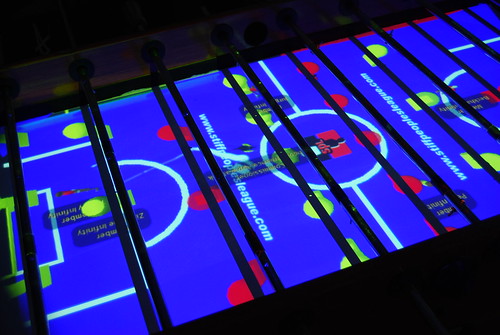
Stiff People’s League


I learned about Stiff People's League via a LabCast from MIT that I recently saw. For me this is another example of a strange inversion: This virtual soccer game is primarily played in Second Life but also real people at a foosball table can join the action. But they are really secondary. So when you're inside of Second Life you see these clumsy proxies of real-world people inside of the machine. Tron: "Are there users?". In the Stiff People's League you can see proxy actions of real users. The borders keep melting, possibly faster than the polar ice caps. Let the Ka be with us...